
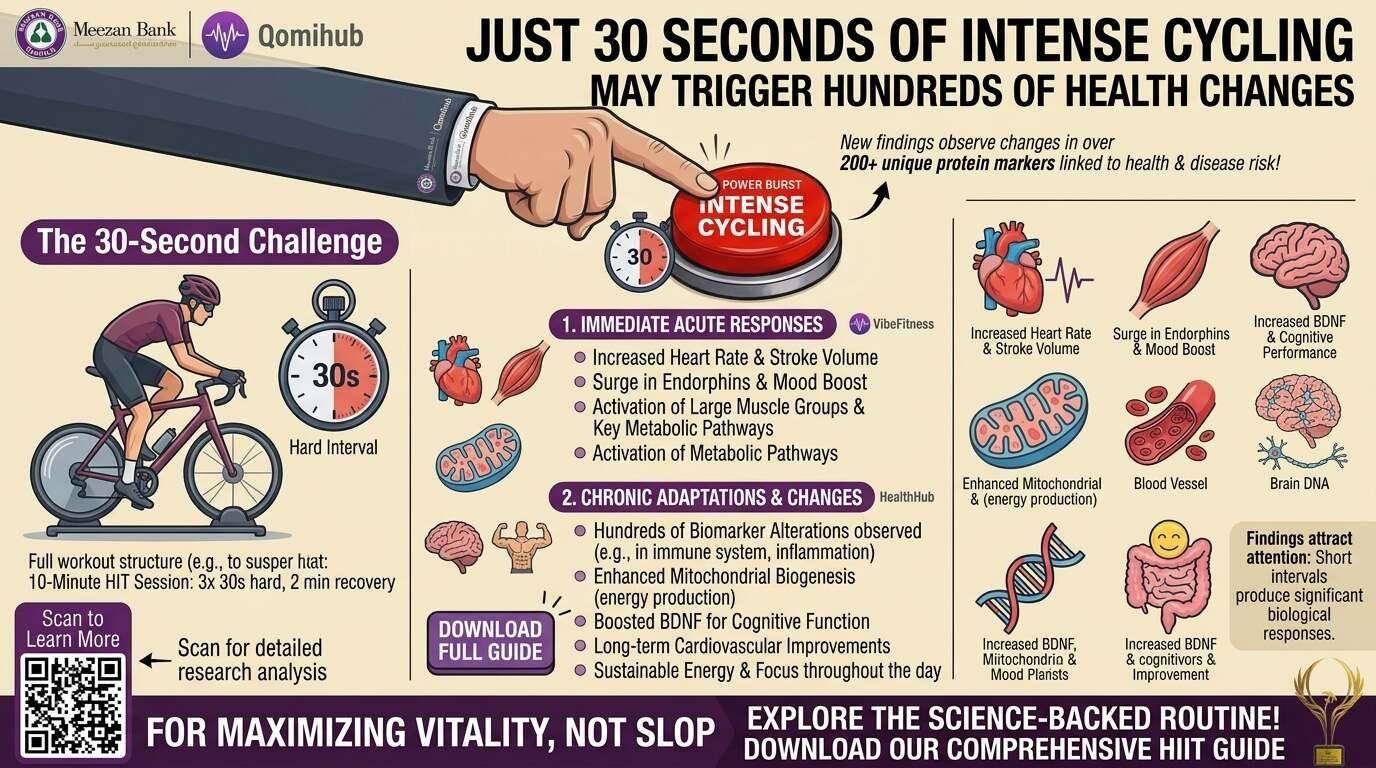
Such a short bout of intense exercise may actually be far more effective for the human body than one would think. The new study indicates that just 30 seconds of intense cycling, followed by a period of rest, can cause the alterations in hundreds of proteins that relate to health, metabolism, and the risk of developing certain diseases.
These results have become especially intriguing as they indicate that such a short bout of intense physical activity can lead to significant changes in the body of a person.
The research, carried out by scientists from the University of British Columbia, and which is published in the journal Cell Reports Medicine, looks at the body's reaction to various forms of exercise intensity.
What Did the Study Find?
It was discovered that high-intensity cycling of 30 seconds and four minutes of recovery led to changes in 714 proteins in the blood relevant to human health.
On the other hand, moderate cycling resulted in changes to only seven proteins.
This does not imply that a 30-second workout is always more effective than a longer one. Rather, this finding suggests that exercise intensity may have an effect on the response of the body on a molecular level.
The scientists hypothesized that these short bursts of activity might trigger biological pathways responsible for metabolism and energy use among others.
How Can Intense Exercise Affect Fat Metabolism?
One of the surprising discoveries made was that of a molecule known as Lac-Phe, a molecule created within the body through strenuous exercises.
This particular molecule had been previously linked to the regulation of appetite and the metabolism of fats. Scientists discovered that this molecule, at high quantities, triggered the activation of over 1,600 genes within the fat tissues.
This discovery means that exercising vigorously can have an effect on how the body metabolizes energy. Nevertheless, further research needs to be done to establish how these molecular changes affect health.
Could Short Workouts Reduce Disease Risk?
In addition to that, the scientists studied health data on more than 53,000 individuals.
Specifically, proteins involved in the response to strenuous physical exercise have been shown to reduce the risk of suffering from various diseases, such as:
- Cardiovascular disorders
- Type 2 diabetes
- Obesity
- Other metabolic disorders
- Aging biomarkers
Noteworthy is the fact that all these diseases have an impact on millions of people around the globe.
The study provides evidence about biological pathways and associations rather than a guarantee of specific health outcomes.
Why Short Bursts of Exercise Could Matter
It can be hard for many people to find the time for a lengthy workout.
There is always work to do, a family to take care of, and even commutes which make it hard to find one hour to go to the gym.
Perhaps, bursts of energetic activities could be another way to introduce exercise into their daily schedule.
Perhaps, some individuals may add periods of increased speeds while cycling to a moderate exercise session. This technique is common in interval training exercises.
What is crucial to remember is that brief does not mean easy. Intense exercise requires lots of effort from the lungs, the heart, and muscles.
Is 30 Seconds of Intense Cycling Enough?
No: The study does not prove that everybody needs to exercise for merely 30 seconds.
It only proves that a short period of vigorous exercise is sufficient to cause physiological changes.
To have overall fitness, a blend of cardiovascular exercise, strength training, physical activities of daily living, and proper recovery may be more helpful than focusing on only one short exercise program.
Those who are beginners in exercise might benefit from slowly building up their intensity levels instead of starting off with a high-intensity cycling program.
Who Should Be Careful With High-Intensity Exercise?
Not everyone on the same level of intensity of exercise will necessarily benefit from it.
Those individuals who are elderly, inactive, pregnant, recently ill or injured, or suffering from an underlying health condition may want to seek guidance from a healthcare provider about an exercise program.
An individual that experiences chest pains, difficulty breathing, dizziness or fainting while exercising should stop the exercise and consult with their doctor.
The purpose should be to exercise safely and consistently, not necessarily to exert oneself.
Moderate Exercise Still Has Important Benefits
However, the results should not be seen as implying that moderate exercise is ineffective.
Moderate exercises such as walking, jogging, swimming and cycling among others may improve heart fitness, movement and general health.
To some people who are just beginning an exercise program, moderate exercise may be a more realistic approach compared to high intensity exercises.
Continuity is equally crucial. Exercising regularly for months or even years may prove more useful than doing intense exercise on certain occasions.
Also Read: How to Lose Weight: 12 Simple, Sustainable Tips
What This Research Could Mean for the Future
This study contributes to an increasing scientific interest in studying the influence of exercise intensity on the molecular reaction of the body.
There is an increasing number of studies of biological signals such as proteins and hormones in order to learn about the connection between exercise and good health.
This study could ultimately assist scientists in developing personalized exercise routines depending on the age, level of fitness, metabolism and general health of the individual.
However, additional studies are needed in order to determine whether the observed short-term changes lead to reduction of diseases in the long term.
The Bottom Line
As little as 30 seconds of intense cycling might actually lead to far-reaching modifications to the proteins of the body, says new research.
The study revealed that a single bout of intense cycling coupled with recovery period had an effect on hundreds of proteins associated with one's health and had links with various metabolic pathways and fat cells.
Though the results are promising, they shouldn't be taken as an indication that everybody can just start doing 30 seconds of exercise instead of their usual workouts.
💬 Comments
Be the first to comment.
Login to leave a comment.